
ABOUT THE GLOBAL CARBON FIBER MARKET

Below is a Turkish translation of an article published in the January-February 2020 issue of CompositesWorld magazine.
World Carbon Fiber Market
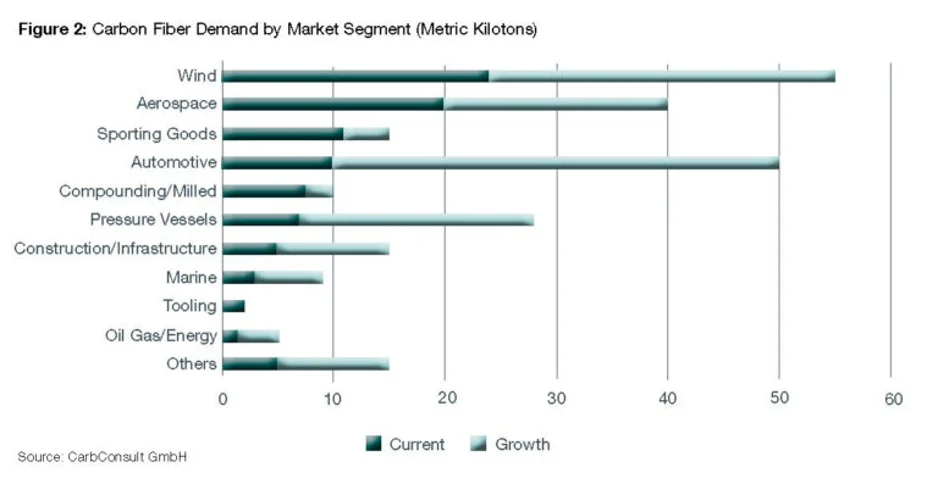
2019 yılında, dünya genelindeki karbon elyaf talebi yaklasık 100.000 tonu buldu. Havacılık, rüzgar türbini kanatları ve diğer birçok endüstriyel uygulamada karbon elyaf kullanımının yaygınlasmasıyla artan hacim desteğiyle pazar %10 ila %12 arasında büyümeye devam ediyor. Öngörülebilir gelecek açısından bu orandaki büyümenin devam etmesi beklenmektedir.
The distribution of carbon fiber usage by market segment is approximately as follows:
- Rüzgar enerjisi: %25
- Uzay: %20
- Spor malzemeleri: %10 ila %12
- Otomotiv: %10 ila %12
- Injection molded plastic compounds: %5 to %8
- Pressure vessels: %5 to %8
- Construction and infrastructure: %5 to %8
- Diğer pazar segmentleri: %15
As new applications and programs are developed, significant growth potential is seen for all market segments.
Karbon elyaf takviyeli polimerin (CFRP) herhangi bir uygulamada kabul görmesi için hem teknik hem de ekonomik fayda sunması gerekmektedir. Çoğu uygulama için karbon elyaf kullanmanın ana teknik yararı, malzemenin daha hafif olması, daha verimli yapılar sunmasını sağlayan yüksek mukavemet-ağırlık performansıdır. Örneğin, rüzgar türbini kanatlarına karbon elyaf katılması daha hafif, daha verimli aerodinamik sekillerin ve kanat tasarımlarının yapılmasını sağlamıstır. Otomobillerde, karbon elyaf takviyeli polimerden yapıldığında bazı parçaların ve montajların ağırlığı %50 ila %75 azaltılabilir, böylece yakıt tüketimi ve CO2 performansı iyilestirilebilir veya bataryayla çalısan elektrikli araçların sürüs menzili önemli ölçüde uzatılabilir. Gelisme ve benimseme mevcut hızda devam ederse, gelecekteki pazar segmenti senaryosu bugünkünden çok farklı görünebilir. (bkz. Şekil 2.)
Another factor affecting the market is the tightening capacity of the carbon fiber manufacturing industry. All carbon fiber manufacturers combined may have a nominal capacity of 140,000 tons or more. However, considering the mix and variety of products produced and the inherent destructive effects of the process, the effective net sector capacity is likely only around 110,000 tons. Consequently, manufacturers in various parts of the world, including North America (Mexico and the USA), Europe (Hungary and Turkey), and Asia (China), have announced new facilities and capacity expansions.
Volume is a crucial factor for carbon fiber to gain a larger share of the overall composite market. Lower costs are needed for high-volume applications and wider adoption of carbon fiber reinforced polymer (CFRP); in other words, both the cost of carbon fiber material and the production cost of CFRP parts must decrease. While one airplane is produced per day, cars are produced per minute; this timeframe decreases on a volume scale for wind turbine blades, sporting goods, and other applications. The volume and cost issue is similar to the “chicken and egg” problem: which comes first? However, we are confident that if industry experts work together, high-volume applications will materialize, ultimately leading to lower costs and increased adoption rates.
Meanwhile, there are other problems as well. For example, the challenge of mass adoption of carbon fiber reinforced polymers in cars, millions of which are produced daily, goes beyond purely technical and economic considerations. Sustainability and recycling also need to be addressed. However, these issues are more or less addressed throughout the value chain.
In summary, the market for carbon fiber materials and carbon fiber reinforced polymer products is growing steadily and robustly. Demand has caught up with existing capacity, and additional capacity has been announced and will be commissioned in a timely manner. However, as always, the secret to continuing to unlock the potential demand for carbon fiber across all end-use applications lies in using the right materials in the right way. The future is promising for carbon fiber, and interesting developments are expected in the next few years.